

“How was your day?”
“Fine.”
“What did you do?”
“Nothing.”
Sound familiar? “How was your day?” is such a natural question to ask when we’re interested in our child’s world. But surprisingly, it can also be quite a big question for a child’s brain to answer. It’s not that they are not interested in telling you.
“How was your day?” is a big cognitive ask for little minds
To answer, children need to mentally scan several hours of experiences, retrieve memories, decide which moments are important, organise them and find the words to tell us about them.
Children don’t always remember their day as one neat, chronological story. They may remember moments, feelings, people, games and little pieces of experience.
So a broad question can be a bit like opening a huge filing cabinet and saying, “Find me something interesting!”
Some children may find it even harder
Children differ in how easily they retrieve memories and organise experiences into words.
For children who find things such as memory retrieval, executive functioning, language organisation or mental imagery more difficult, broad questions can be particularly challenging.
Their one-word answer doesn’t necessarily tell us how much they want to talk. Sometimes the question is simply too big for their brain at that moment.
Make the question smaller
Rather than searching the whole day, we can give children a smaller place to look:
- Who did you play with today?
- What was your favourite part of lunch?
- Did you draw anything?
- Did anything feel tricky today?
- For Tedology schools – what did the bear say today.
Specific questions give the brain a memory cue. Once a child finds one little moment, the conversation can often grow naturally from there.
The aim isn’t to get a perfect account of the school day. It’s simply to create little opportunities for conversation.
So next time “How was your day?” gets a “fine”, try giving them some time and then helping their brain find one small moment.
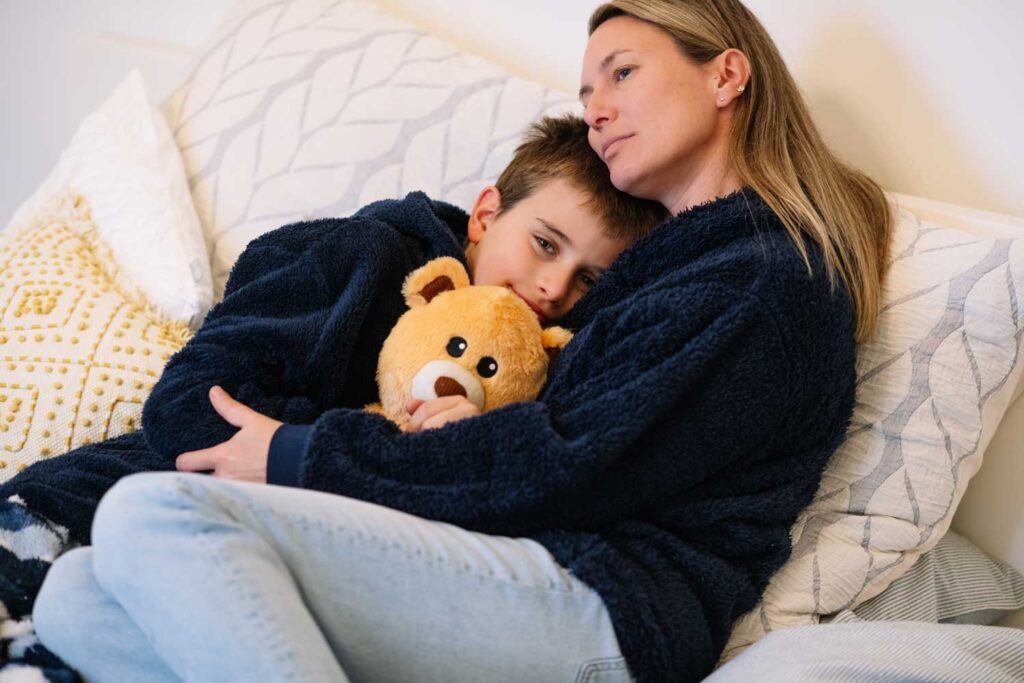

Meet Teddy
While the Tedology Bear may look like a teddy bear, it is actually an emotional wellbeing kit designed to help children talk about feelings, feel calmer, and manage big emotions through connection and play.